

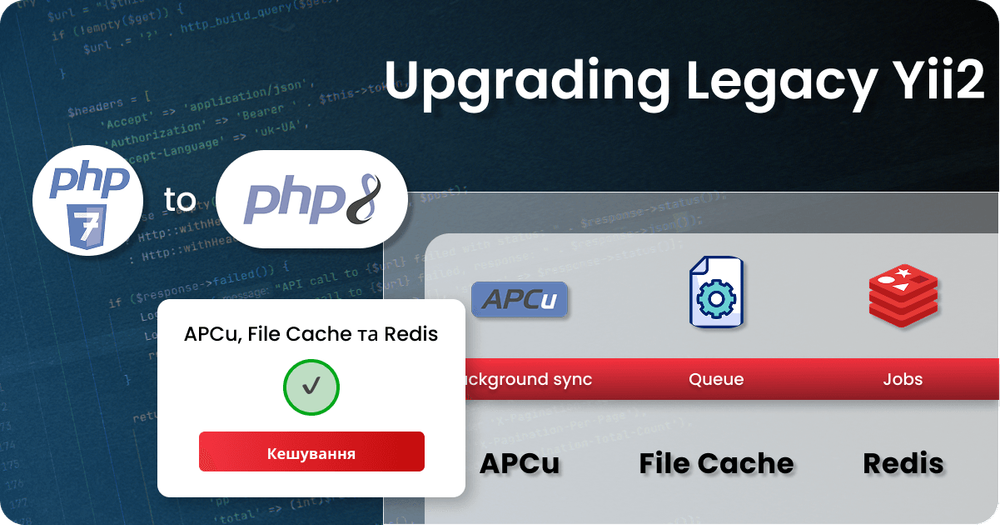
I led a full technical modernization of a large Yii2 web platform: upgraded the project from PHP 7.1 to PHP 8.2, updated Composer dependencies, resolved compatibility blockers, refactored critical external API integrations, moved long-running processes to background queues, implemented sync status tracking and caching, and partially applied an updated design to the homepage as the first step of a gradual full-platform redesign.
The project had a legacy architecture, business-critical integrations, and a wide range of content and catalog-like entities. The main goal was to safely modernize the technical foundation, improve stability, performance, and maintainability, and keep the business running without interrupting ongoing product development.
Business goals
- Upgrade an outdated Yii2 platform to a modern and secure PHP version without rebuilding the product from scratch.
- Maintain stable operation across key sections, records, listings, promotional entities, and service workflows.
- Reduce technical debt in Composer dependencies and eliminate critical compatibility risks.
- Redesign external API synchronization logic to make it more stable, manageable, and support-friendly.
- Introduce queues and background processing for long-running operations.
- Add transparent sync status tracking for administrators and support teams.
- Start a phased migration to a new UI without slowing down product evolution.
What was done
- Performed a full upgrade from PHP 7.1 to PHP 8.2, taking into account language-level changes, code compatibility, and third-party library behavior.
- Updated Composer dependencies, resolved version conflicts, removed outdated packages, and adapted the codebase to the new stack.
- Created and maintained a custom fork of an unsupported package to preserve required functionality and ensure compatibility with the updated environment.
- Refactored external API synchronization logic to make it more predictable, fault-tolerant, and easier to support in the long term.
- Moved heavy and time-consuming operations into queues and background jobs, reducing load on user-facing workflows.
- Implemented sync status tracking, error handling, retry logic, and clearer process diagnostics.
- Added caching to speed up common scenarios, reduce unnecessary API calls, and improve backend performance.
- Partially applied the updated design to the homepage and prepared the foundation for a step-by-step UI replacement across the product.
Key technical solutions
- Legacy code upgrade - adapted the existing codebase to PHP 8.2 requirements without breaking business logic.
- Dependency management - audited packages, updated versions, resolved conflicts, and maintained compatibility between framework, PHP, and third-party libraries.
- Custom package fork - instead of blocking the upgrade because of an abandoned dependency, I introduced a controlled solution that could be maintained and extended further.
- Background synchronization - critical integrations were moved to the background, which improved UI responsiveness and process reliability.
- Sync status tracking - implemented a transparent status model to track progress, errors, and processing results.
- Caching - optimized data access and reduced unnecessary internal and external requests.
- Phased redesign - started the UI modernization without stopping product development, allowing technical upgrades and visual improvements to move in parallel.
Challenges and how they were solved
- Old dependencies incompatible with PHP 8.2 - performed a full dependency audit, upgraded compatible libraries, and created a custom fork for a critical unsupported package.
- Fragile external API synchronization logic - rewrote the sync flow with a stronger focus on stability, controlled error handling, and maintainability.
- Long-running operations blocking user workflows - moved heavy processing into queues and background jobs.
- Difficult sync diagnostics - introduced status tracking, readable states, and clearer execution control.
- Need to refresh the design without a full product rewrite - used a phased rollout approach, starting with the homepage and preparing the project for further UI migration.
Architecture approach
As part of the modernization, I strengthened the technical architecture of the platform: critical processes were moved into more maintainable services, heavy tasks were shifted to the background, synchronization gained a clearer lifecycle and state control, and integration logic became more isolated and easier to extend. This made the project not only more modern from a technical perspective, but also more sustainable for long-term support and scaling.
Technologies
PHP 8.2, Yii2, Composer, API integrations, background jobs, queues, caching, legacy refactoring, custom package forks, phased UI migration, performance optimization, modernization of business-critical systems.
Business impact
- Reduced technical risk by moving the platform from an outdated stack to a modern supported environment.
- Improved product stability through upgraded dependencies, controlled integrations, and background processing.
- Simplified future maintenance thanks to clearer architecture, ownership over critical dependencies, and better diagnostics.
- Improved performance with caching and by removing heavy operations from user-facing scenarios.
- Prepared the product for future growth on both backend and frontend sides, including further redesign and scaling.
Need to modernize a legacy PHP or Yii2 project without disrupting the business?
I can help you audit the platform, plan a safe upgrade, update dependencies, stabilize integrations, move heavy processes to the background, and prepare the product for future scaling and redesign.