

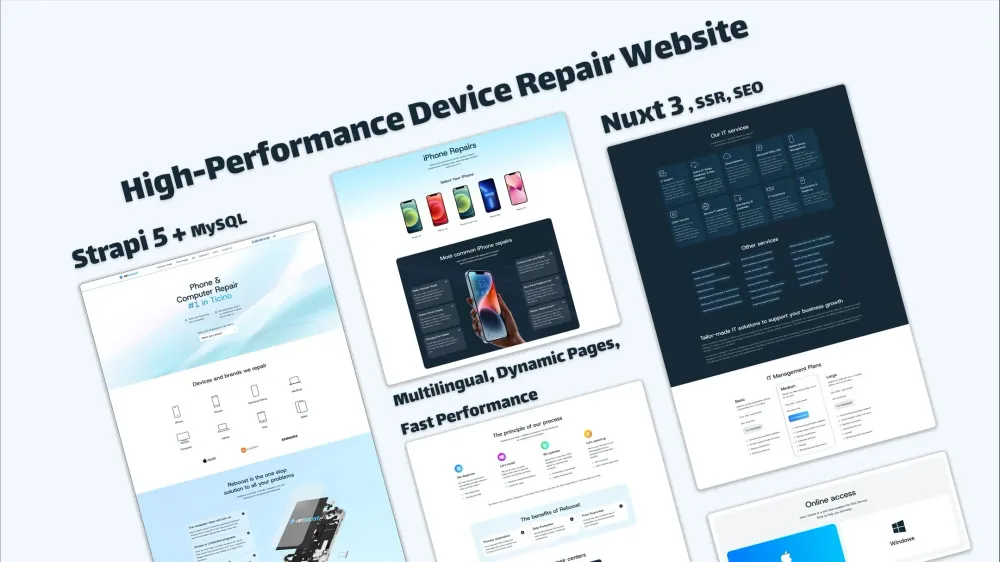
This project is not just a corporate website for a service center, but a full-fledged platform for attracting customers from search, converting inquiries into orders, and conveniently managing content by the team without developer involvement.
The architecture follows a “content first” principle: editors manage pages, service categories, device lists, and blog posts directly in the Strapi v5 CMS. The Nuxt 3 frontend runs in server-side rendering (SSR) mode, which ensures “instant” loading speed, excellent Lighthouse scores (around 100 across all metrics), and consistently high rankings in search engines. MySQL is used as a productive and reliable store for structured data.
Key business benefits:
- Noticeable growth in organic traffic thanks to technical SEO, structured data, and speed.
- Higher conversion to inquiries: service pages that sell, clear CTAs, simple forms, and fast rendering.
- Minimal maintenance costs: everything is edited in the CMS, with no manual code changes.
- Scalability: it’s easy to add new services, device models, cities, and languages — the platform is ready to grow.
Objectives and goals
- SEO-optimized foundation: robust technical base, semantic markup, clean URLs, multilingual support, and high performance.
- Full content control: pages, services, devices, blog — everything is edited via Strapi v5.
- Premium speed: Nuxt 3 SSR rendering, aggressive caching, image optimization, and lazy loading.
- Readiness to scale: new languages, regions, subdomains/directories for locales, extensible content types.
- Security and stability: modern hosting approaches, security policies, form protection, and access control.
Solution architecture
Technology stack
- CMS: Strapi v5 (flexible content types, components, i18n).
- Frontend: Nuxt 3 in SSR mode for “clean” HTML on first paint, fast TTFB, and SEO friendliness.
- Database: MySQL — structured relations, indexes, vertical/horizontal scaling.
- Images & media: automatic generation of multiple sizes in Strapi + nuanced lazy loading on the frontend.
- Caching: multi-layered — at the CDN/reverse proxy level, SSR pages, and API responses (where safe).
- Analytics: integration with web analytics systems and call tracking (if needed).
Interaction logic
- A user opens a page → SSR returns ready-made HTML (fast first pixel, lower bounce).
- Dynamic content (services/devices/articles) is fetched from Strapi via optimized REST/GraphQL requests.
- Nuxt hydration: after the first render, the interface activates with smooth transitions without full reloads.
Content model in Strapi v5 (what and how is edited)
Core entities:
Pages (landing, about, contacts, warranty, FAQ): modular sections (hero block, benefits, case studies, service grid, testimonials, CTA).
Services: category (phone/laptop/tablet repair), description, price ranges, included work, warranty, FAQ, schema.org.
Devices: brand, model, device type, common issues, estimated prices, related services.
Blog: articles with multilingual metadata, covers, and internal interlinking.
Geo pages (if needed): “iPhone repair in Lviv/Kyiv/Odesa” with local search signals.
Multilingual policy (i18n):
- Each record has translations, localized URLs and localized SEO fields (title, description, OG tags).
- The language switcher generates correct hreflang and canonical links.
SEO fields for each entity:
- Page heading (H1 and <title> may differ if needed).
- Meta description (120–160 characters, value proposition + key phrase).
- Open Graph / Twitter Cards (image with the right aspect ratio).
- Schema.org: Organization, LocalBusiness, Service, Product (for models/repairs), FAQPage, BlogPosting.
Frontend: Nuxt 3 (SSR) and performance
- SSR + cache: pages are rendered on the server and popular URLs are cached — this provides fast TTFB and stable Core Web Vitals.
- Critical CSS: extracted for the first screen; everything else is loaded asynchronously.
- Images: served in reasonable sizes with srcset, lazy loading, and decoding="async". Hero blocks have a mobile variant.
- Code splitting: only the bundles needed for a specific page.
- Prefetch/Preload: boosts navigation between pages without visible flicker.
Result for the user: pages open quickly even on mobile with 3G/4G; the site feels lightweight and modern, and search engines recognize the high-quality technical implementation.
Technical SEO: what’s done “under the hood”
- Clean slugs and multilingual URLs: /uk/poslugy/remont-iphone, /en/services/iphone-repair, etc.
- hreflang + canonicals: correctly indicate language versions and prevent duplicates.
- Schema.org markup:
- LocalBusiness (or Organization) with contacts, opening hours, and addresses of service centers.
- Service for service pages (name, description, device type, region, warranty).
- Product/Offer — for models and repairs with variable pricing (as a range or “from”).
- FAQPage — on pages with frequently asked questions.
- BreadcrumbList — “breadcrumbs” for richer snippets.
- Micro-optimizations:
- H1–H3 headings with target keywords and LSI.
- ALT texts written naturally, not keyword-stuffed.
- Internal linking: from services to relevant blog posts and vice versa.
- XML sitemap with multilingual support, automatic lastmod.
- robots.txt, control over indexing of technical pages.
- Core Web Vitals: low CLS, fast LCP, high INP — achieved through SSR, resource optimization, and thoughtful rendering.
Editor experience (no developer needed)
- Ready-made blocks (hero, benefits, pricing, testimonials, CTA, FAQ) can be added in any order.
- Modularity: you create a new service “MacBook battery replacement” — fill in the copy, warranty, “from…” price, images, FAQ → the page is ready.
- Unified tone of voice: curated fields for copywriting, hints on length, microcopy for CTAs.
- Translations: one click — and you’re editing the English/Ukrainian version.
Security and reliability
- Roles and permissions in Strapi: editors see only the collections they need.
- Form protection: validators, rate limiting, honeypot/reCAPTCHA (if necessary).
- CSP, X-Frame-Options, HSTS: modern policies for the frontend.
- Updatability: dependency versions are tracked; the environment is easy to reproduce (Docker stacks if needed).
Scaling and geo strategy
- New cities/regions: add geo pages with local addresses, opening hours, and local FAQs.
- New languages: enabled out of the box; adding a new locale is repeatable and controlled.
- Device catalogs: a separate list of brands/models; quickly add users’ common “pains” (e.g., “cracked screen,” “water damage”).
Marketing features that drive conversions
- Powerful hero section: concise offer + shop/lab photos/video, “Start repair” with microcopy “we respond within 5 minutes.”
- Social proof: photo testimonials, partner badges, warranty terms, before/after cases.
- Price segments: “from…,” “typical scenarios” (economy/standard/premium), transparent SLAs.
- FAQ that removes objections: “How long does diagnostics take?”, “What about warranty?”, “What if the part doesn’t fit?”
- Instant contact: click-to-call, web chat, WhatsApp/Telegram, a two-click order form.
- Content marketing: articles like “how to know you need a replacement,” “how to prepare for repair,” “common owner mistakes.”
How we increase search visibility (practical plan)
- Semantic core: “iPhone repair [city],” “screen replacement [model],” “laptop repair [brand].”
- Site structure: home → service categories → specific models/issues → blog/FAQ.
- Helpful content: simple explanations, real examples, short videos/photo illustrations.
- Internal links: services ↔ models ↔ articles (boosts relevance).
- Geo signals: NAP data (name, address, phone), opening hours, reviews, LocalBusiness microdata.
- Technical cleanliness: speed, sitemap, robots, canonicals, hreflang, no “junk” pages.
Analytics and A/B testing
- Event tracking (CTA clicks, form submissions, click-to-call).
- A/B testing of headlines and CTAs (“Free diagnostics” vs “Money-back guarantee”).
- Click/scroll maps — we optimize block order and page length.
Business outcomes (what the client gets)
- Predictable organic growth: due to technical SEO and a content plan.
- Improved conversion: clear offers, fast forms, minimal friction in the user journey.
- Reduced time-to-market: new pages/services are launched by the content team.
- Load resilience: the architecture is ready for seasonal peaks and geographic expansion.
Q&A (short FAQ)
Can the site be expanded into a services marketplace?
Yes. The current model allows adding new collections (technicians, partner locations, booking slots, request statuses).
Is price/model import supported?
Yes. We create endpoints/admin scripts to import from CSV/Google Sheets/vendor APIs.
Is there a risk of “overdoing” SEO?
No — we avoid keyword stuffing. All semantics are woven in naturally and provide real value to the reader.
This multilingual device repair website is an acquisition and sales tool, not a “business card.”
The combination of Strapi v5 (flexible content, editor friendly), Nuxt 3 (SSR) (speed + SEO), MySQL (stability and scalability), and thoughtful marketing logic (offers, CTAs, FAQ, social proof) gives the business a competitive edge: more traffic, more inquiries, and lower maintenance costs.
Ready to deploy something similar for your brand, regions, and product niches:
— Get a free consultation and a launch plan (with deadlines and budget).
Need a similar project for your business?
Write to me — I will propose the architecture, content structure, work plan, and budget.