

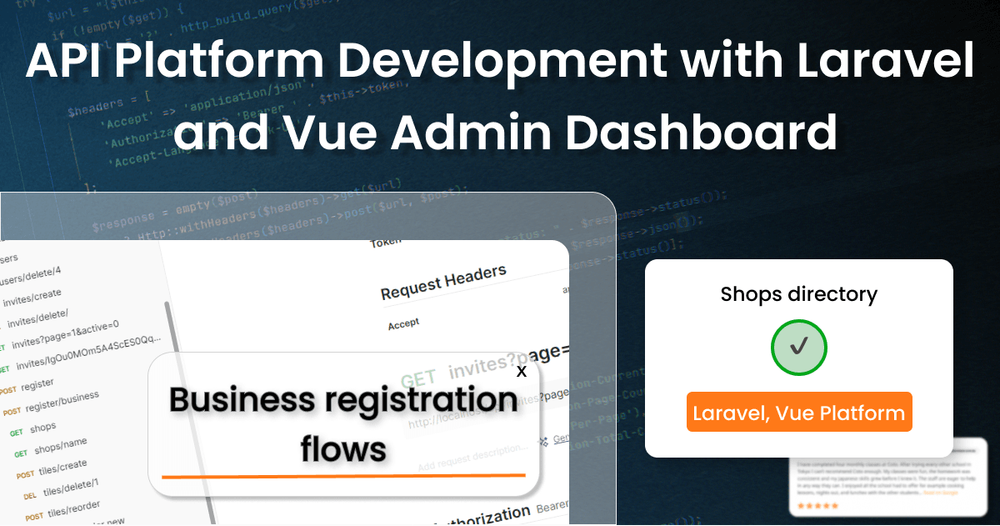
API-first mobile platform development with Laravel 12 and Vue admin dashboard
I developed an API service for a mobile application together with an administrative dashboard for managing content, business entities, users, and invitation workflows. The project was built with Laravel 12 for the backend and Vue.js for the web-based admin panel, combining a mobile-oriented API layer with an internal management interface. As a result, the product evolved into more than just a JSON API - it became a structured backend platform supporting both the mobile experience and operational management.
Based on the available Postman collection, the system included authentication flows, user and invite management, business registration, shop and location entities, map-related resources, media handling, and content-oriented tiles. This suggests a mobile-first platform with a CMS-like admin area for managing structured business and location data used by the client application.
Objectives and Goals
- Design a reliable API layer for a mobile application with a clear resource structure and business workflows.
- Build an admin dashboard in Vue for managing content, users, business entities, and invitation flows.
- Implement secure authentication, login and logout flows, profile endpoints, and password recovery scenarios.
- Create management modules for businesses, locations, maps, content tiles, images, and external links.
- Provide efficient internal workflows for content operations and account administration.
- Build a scalable technical foundation for future mobile product growth and feature expansion.
Architecture and Key Components
Laravel 12 API as the core backend platform
The server-side architecture was built around Laravel 12 as a centralized API layer for both the mobile application and the admin interface. This made it possible to keep business logic, access rules, entity management, and operational workflows within a single backend layer. The result was a stable foundation for mobile client interactions and an efficient management experience for internal teams.
Authentication, accounts, and invite-based workflows
The platform included core account-related scenarios such as login, profile retrieval, logout, password reset, user management, invite creation, invite validation, and token-based registration flows. There was also a separate business registration scenario, which indicates support for different account types and controlled onboarding of business users into the system.
Business entities, shops, and locations management
One of the central product layers focused on business objects, shops, and location management. The API supported shop listing and lookup, location creation and updates, contact details, coordinates, addresses, business hours, and additional external links. This points to a product where the mobile application consumed structured business data, while the admin dashboard ensured that the content stayed accurate and manageable.
Content tiles and map-related presentation
A separate part of the system was dedicated to content tiles and map-driven presentation logic. The collection contains create, update, delete, and reorder operations for tiles, along with map management endpoints associated with shops and locations. This is consistent with a mobile product that presents businesses or locations through structured visual sections, promotional blocks, or navigational content editable from the dashboard without code-level changes.
Media handling and additional content management
The platform also supported image uploads, default image selection, media deletion, and CRUD operations for links related to locations and content entities. This means the administrative area was designed not only for plain structured data, but also for full visual and reference content management used by the mobile product.
Vue admin dashboard for management operations
The Vue-based admin dashboard served as the operational control layer on top of the API platform. Through the dashboard, managers could work with users, invitations, business records, locations, tiles, and media assets. This enabled fast internal operations, convenient content updates, and a more controlled lifecycle for the product’s structured data.
Main System Modules
- Authentication and profile management
- Password reset workflows
- User management
- Invite management
- Business registration flows
- Shops directory
- Locations management
- Map management
- Tiles and content blocks management
- Image uploads and media handling
- External and social links management
- Vue-based admin dashboard
Results for the Product
- Delivered a centralized backend API for a mobile application with clearly structured business entities.
- Built an administrative dashboard for managing content, users, and business-related data.
- Implemented a flexible model for handling locations, shops, maps, media assets, and content tiles.
- Added invite-based onboarding workflows for controlled account creation and administration.
- Created a scalable backend foundation for a mobile product supported by practical internal workflows.
This project is a strong example of an API-first platform built with Laravel 12 for a mobile product, where the backend served not only as a data provider for the client application, but also as the foundation for a complete administrative ecosystem. The combination of Laravel API and Vue dashboard made it possible to build a product that was both user-oriented on the mobile side and operationally efficient for the internal management team.
Need a Similar Project?
I build Laravel APIs and Vue admin dashboards for mobile applications, SaaS products, and business platforms. If you need a backend for a mobile app, a web admin panel, a CMS-like management interface, or an API-first architecture for a digital product, I can design and develop a solution aligned with your business model and growth goals.